
China Threatens EU After Carbon Border Tax Takes Effect
By Zhao Xuan, Luo Guoping and Wang Xintong

Beijing has vowed to take “all necessary measures” after the European Union’s carbon border tax fully took effect, a move that analysts said could significantly raise costs for Chinese exports such as steel and threaten their competitiveness in Europe.
The Carbon Border Adjustment Mechanism (CBAM), which fully entered into force on Thursday following a two-year transitional phase, requires importers of steel, aluminum, cement, fertilizers, electricity and hydrogen to purchase certificates to cover the carbon emissions embedded in their products. The mechanism is designed to force importers to pay the difference between the carbon price in the country of production and that in the EU, aiming to prevent “carbon leakage,” such as when companies based in the EU could move carbon-intensive production abroad to take advantage of lax standards.
In response, the Ministry of Commerce said in a statement on Thursday that while China is willing to cooperate on global climate challenges, it “will firmly take all necessary measures against any unfair trade restrictions to safeguard its development interests, the legitimate rights and interests of Chinese enterprises, and the stability of global industrial and supply chains.”
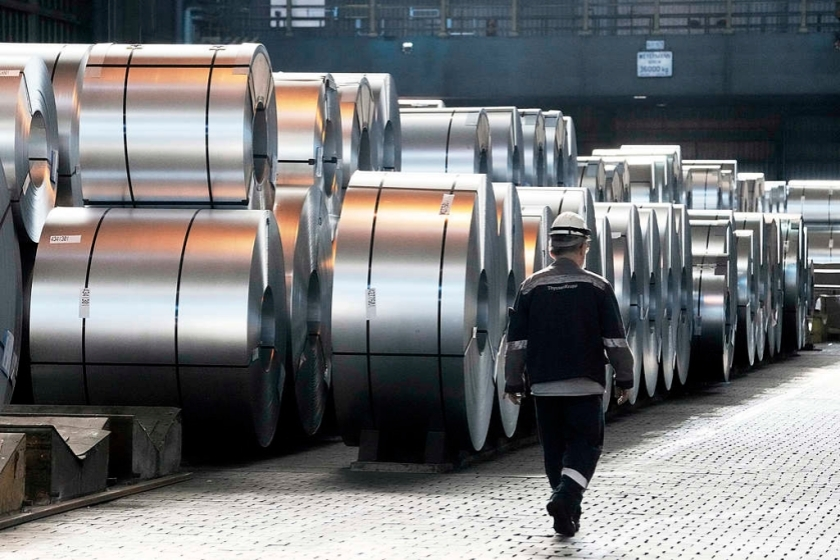
The steel industry is expected to face the most immediate financial pressure from the new regime. According to consultancy Fastmarkets, steel products account for more than 70% of the trade volume covered by CBAM. Because Chinese steel production relies heavily on the carbon-intensive blast furnace-basic oxygen furnace route, Chinese exporters are projected to be the largest buyers of CBAM certificates.
A steel industry analyst noted that while the overall volume of Chinese steel exports to the EU is relatively modest, shipments largely consist of high-value products that are critical to maintaining competitiveness in the European market. China exported nearly 2 million tons of finished steel products to the EU in 2024, accounting for 7.2% of the bloc’s total steel imports, according to the European Steel Association.
Adding to the pressure, the European metals association EUROMETAL published a report in December indicating that the European Commission had raised the default carbon intensity values for several countries, including China.
An analyst in the low-carbon sector told Caixin that if the EU does not accept an enterprise’s reported emissions data, the system applies default values that are typically higher than actual emissions. Fastmarkets estimated that utilizing default values would add approximately 144 euros ($168) per ton to the cost of Chinese steel slab exports to the EU. This is significantly higher than the estimated levies on steel from Brazil, Turkey, Vietnam, South Korea and Japan, which range from roughly 22 euros to 81 euros per ton, though lower than the projected costs for Indian and Indonesian products.
The policy’s impact is magnified by the disparity between carbon pricing in the two markets. Importers must bridge the gap between their local carbon cost and the EU standard. With China’s domestic carbon price hovering around 70 yuan ($10) per ton compared to the EU’s approximately 90 euros per ton, the differential remains steep.
CBAM-related costs could raise total expenses for importers from industries such as steel, aluminum, fertilizers and cement by more than 12 billion euros from 2026, equivalent to about 15% of the value of those imports, according to Fastmarkets.
Contact reporter Wang Xintong (xintongwang@caixin.com)
caixinglobal.com is the English-language online news portal of Chinese financial and business news media group Caixin. Global Neighbours is authorized to reprint this article.
Image: HadK – stock.adobe.com