Simandou’s First Ore Shipment Stalls as Locomotive Rift Deepens
By Luo Guoping, Bao Zhiming and Denise Jia

The highly anticipated first shipment from Guinea’s Simandou iron ore project has remains stuck at anchor more than two weeks after loading began, as a dispute over locomotives and rising geopolitical friction stall progress at one of the world’s largest untapped iron ore reserves.
On Nov. 11, Simandou began loading 9,850 tonnes of ore at Marébaia anchorage onto the Winning Youth, a 200,000-ton Capesize bulk carrier operated by project stakeholder Winning International Group. Despite a floating transfer platform capable of moving 5,000 tonnes per hour, the vessel still has not departed.
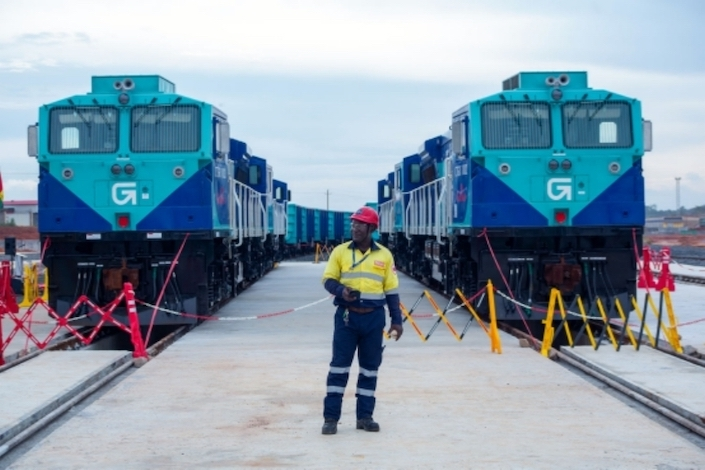
Sources told Caixin that mine output is not the bottleneck. The core issue is insufficient rail transport: only four locomotives from U.S.-based Wabtec Corp. have arrived, allowing just two engines per train, severely limiting how much ore can be transported from the mine to the coast each day.
The situation escalated when Guinea’s government refused to allow Chinese-built locomotives, already delivered to port, to be used in the project. Officials demanded the locomotives be reloaded onto ships, underscoring a deeper power struggle between Western and Chinese interests within the project.
The locomotive standoff
Simandou uses a “rail-river-sea” logistics chain. Ore is transported by rail to Marébaia port, shipped 20 nautical miles offshore via barges, and then loaded onto a Very Large Ore Carrier (VLOC) using floating platforms. Delays have grown costly: the Winning Youth has received 13 barge shipments totaling roughly 150,000 tonnes, with charter costs estimated at over $600,000 during its idle period.
Compounding delays, the primary floating transfer unit Winning Simandou 1 was withdrawn from Simandou service on Nov. 26 and reassigned to bauxite transport. Its duties were transferred to a smaller, less efficient platform, Boke Winning Star, further slowing operations.
The locomotive standoff reflects broader geopolitical calculations. Simandou’s south block is led by Rio Tinto (53%) and a Chinese consortium (47%), while the north block is controlled by the Winning Consortium Simandou (WCS), made up of Winning International, Shandong Weiqiao Pioneering Group Ltd., and China Baowu Steel Group Corp.
Wabtec locomotives, jointly ordered by Rio Tinto and WCS, are being manufactured in India. Rio Tinto expected six units by November, but only four arrived by late September. The Guinea government reportedly prefers Wabtec’s locomotives to balance China’s dominance in the project supply chain.
Nonetheless, WCS had already procured locomotives from China’s CRRC Corp. Ltd., which also supplied trains for its Dapilon-Santou bauxite railway. The Chinese engines are cheaper and easier to maintain, but appear to have been sidelined for political considerations.
In total, the project plans to deploy 143 locomotives and over 7,000 railcars, shared between the northern and southern blocks, and integrated under state-owned Compagnie du Transguinéen (CTG).
Election geopolitics
Observers suggest the ruling Guinean junta, led by transitional President Mamady Doumbouya, is leveraging Simandou to shore up domestic political support ahead of the Dec. 28 election. Doumbouya, who seized power in a 2021 coup, recently declared his candidacy but still lacks international recognition.
The U.S. has condemned the coup, suspended military aid, and removed Guinea from AGOA trade preferences, a trade program granting eligible sub-Saharan African countries duty-free access to the U.S. market for over 1,800 products. In 2024, U.S.- Guinea bilateral trade fell 17.3% to $240 million. Nevertheless, American commercial diplomacy has expanded in Guinea, with Wabtec’s $500 million locomotive contracts cited by the U.S. embassy as strategic investments in transparency and standards.
U.S.-based aluminum giant Alcoa Corp. also has deep roots in Guinea through its long-standing joint venture CBG, which exported 9.2 million tons of bauxite in 2024, trailing only the Winning Consortium and China Henan International Cooperation Group.
Contact reporter Denise Jia (huijuanjia@caixin.com)
caixinglobal.com is the English-language online news portal of Chinese financial and business news media group Caixin. Global Neighbours is authorized to reprint this article.
Image: Igor Groshev – stock.adobe.com