
Shanghai State-Owned Authorities Explore Approaches to Stablecoin Strategy
By Liu Ran and Denise Jia

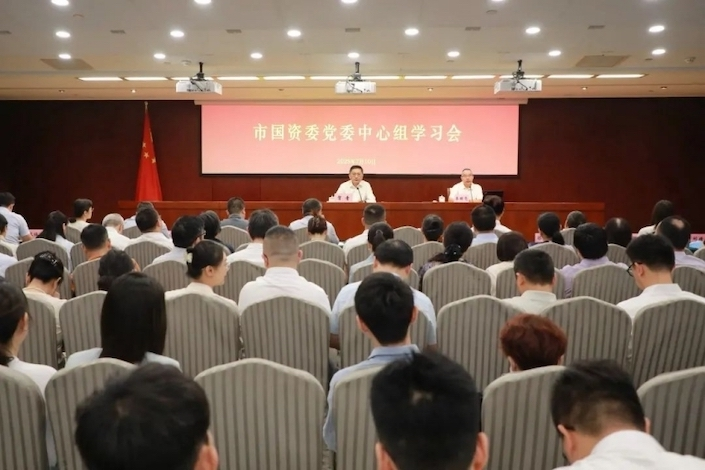
As global interest in stablecoins grows, Shanghai’s state-owned enterprises are taking notice. On Thursday, the city’s State-owned Assets Supervision and Administration Commission (SASAC) held a high-level study session to examine the development of cryptocurrencies and stablecoins — signaling increased attention from local authorities on digital currency strategies.
Stablecoins are a type of cryptocurrency designed to maintain a stable value by being pegged to a reserve asset — usually a fiat currency like the U.S. dollar. Unlike highly volatile coins such as Bitcoin or Ethereum, stablecoins aim to combine the advantages of crypto with the price stability of traditional money.
According to the SASAC’s official WeChat account, the meeting focused on global trends in crypto and stablecoin adoption, potential policy responses and integration with strategic industries.
Li Mingliang, chief policy analyst at Guotai Haitong Securities’ Policy and Industry Research Institute, gave a presentation covering the history, classifications and global regulatory approaches to stablecoins.
His briefing also addressed the challenges and opportunities stablecoin poses and offered policy recommendations for advancing China’s digital currency ecosystem.
He Qing, Party Secretary and Director of the Shanghai SASAC, emphasized the need to remain attuned to emerging technologies and to integrate blockchain and digital currency applications into core industries. He called for innovation-driven strategies and the fusion of technology, finance and industrial capacity — especially in areas such as cross-border trade, supply chain finance and digital asset management.
So far, the Chinese mainland has stayed on the sidelines, maintaining its long-held skepticism about cryptocurrencies based. Authorities cite concerns over their speculative nature, potential threats to financial stability, the loosening of central bank control and their use in illicit activities such as fraud and money laundering.
However, with stablecoins poised to transform cross-borders money transfers — and amid concerns that the U.S. and the dollar will come to dominate this market — some analysts argue that China should support the development of yuan-denominated tokens. These tokens could increase demand for Chinese currency, as they would need to be pegged to and backed 1:1 by yuan-denominated assets.
The meeting was attended by SASAC officials, discipline inspection team members, representatives from affiliated institutions and members of the city’s supervisory group.
A recent report form Guotai Haitong warned that stablecoins are not inherently stable. Their value is only as secure as the credibility of the pegged asset and can be vulnerable to both technical decoupling and market fluctuations. The report added that not all fiat currencies are suited to issue large volumes of stablecoins, predicting that the most trusted currencies would dominate — a “winner-takes-all” outcome.
While the rapid rise of dollar-based stablecoins has sparked debate, the report concluded that they are unlikely to undermine the U.S. dollar system. On the contrary, they could strengthen the dollar’s reach by expanding its utility in digital transactions.
However, dollar stablecoins may pose greater risks to weaker fiat currencies in more volatile economies. Their impact on U.S. short-term debt markets remains limited and largely under Federal Reserve control, despite a partial decentralization of issuance through private firms.
Contact reporter Denise Jia (huijuanjia@caixin.com)
caixinglobal.com is the English-language online news portal of Chinese financial and business news media group Caixin. Global Neighbours is authorized to reprint this article.
Image: 24K-Production – stock.adobe.com