Prabowo’s Resource Crackdown Hits Chinese Investors in Indonesia
By Wen Simin

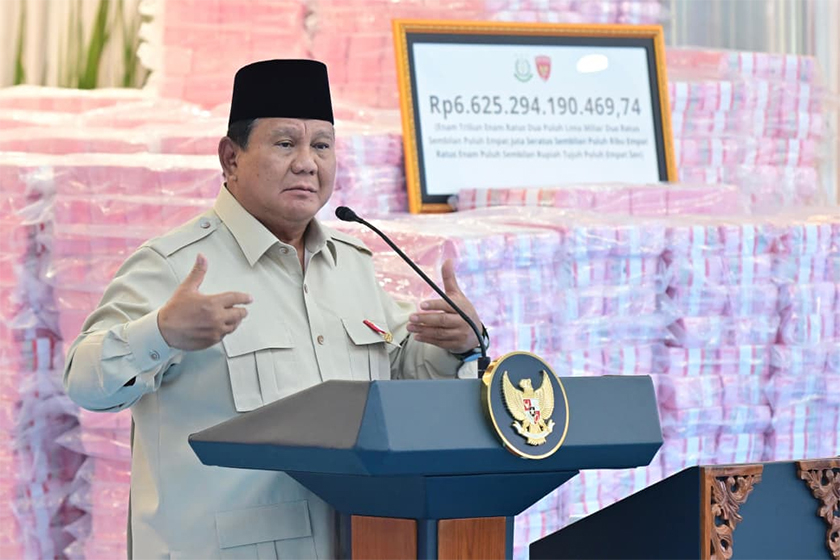
Indonesia is showcasing the fruits of its aggressive crackdown on the resources sector in the most literal way possible: a wall of cash.
On Dec. 24, the Attorney General’s Office displayed a stack of red banknotes amounting to 6.6 trillion Indonesian rupiahs ($425 million), funds recovered from fines for illegal forest use and corruption. President Prabowo Subianto, standing before the neatly stacked currency, declared a victory for state coffers.
“The Task Force on Forest Area Management has successfully recovered more than 4 million hectares of forest, saving the country trillions of rupiahs,” Prabowo said. “In 2026, we will take even bolder steps.”
Since taking office in October 2024, Prabowo has launched a sweeping campaign against illegal exploitation of natural resources, targeting the palm oil and mining industries. In January 2025, he signed Presidential Decree No. 5, mandating a review of all operating and forestry permits. Companies holding business licenses but lacking proper forestry permits face heavy administrative fines and the forced seizure of land.
To enforce the decree, the government established the Task Force on Forest Area Management (Satgas PKH), led by Defense Minister Sjafrie Sjamsoeddin, a longtime ally of the president. The task force includes members of the military, police and prosecutors.
Throughout 2025, the task force collected over 2.34 trillion rupiahs in fines from 20 palm oil companies and one nickel miner. Prosecutors recovered an additional 4.2 trillion rupiahs from major cases. Attorney General Sanitiar Burhanuddin said the revenue potential from administrative fines is immense, projecting 109.6 trillion rupiahs from palm oil and 32.63 trillion rupiahs from mining. The combined total is expected to reach 142.23 trillion rupiahs in 2026, marking one of the largest forestry enforcement actions in the country’s history.
By the end of 2025, the task force had taken control of approximately 4.1 million hectares of illegal plantations and mines — an area roughly the size of the Netherlands. Notably, 1.7 million hectares of confiscated palm oil plantations have been handed over to a new state-owned enterprise, Agrinas Palma Nusantara. Established in February 2025, Agrinas has swiftly become the world’s largest palm oil planter by acreage.
Prabowo described the crackdown as part of an effort to root out decades of corruption and the looting of state assets. “This is just the tip of the iceberg,” he said. “If we calculate carefully, the fines could amount to hundreds of billions of dollars.”
For companies found violating forestry regulations, Indonesia has set a steep fine of 6.5 billion rupiahs per hectare. The crackdown has already touched major foreign players. In September 2025, a section of the massive Weda Bay Nickel mine, a world-class asset majority-owned by China’s Tsingshan Group, was sealed by local authorities due to a lack of permits.
A source close to Tsingshan told Caixin that the Indonesian government is conducting a special rectification campaign involving a number of companies. The source confirmed that 148 hectares of Weda Bay’s operation were involved. “The company fully accepts the rectification,” the source said, adding that the mine covers a vast area of 47,000 hectares and boundaries were not always clear.
The source noted that as the value of the nickel industry rises, local interest groups and regulatory landscapes are becoming more complex. Tsingshan holds a 51.3% stake in Weda Bay Nickel.
As the world’s largest exporter of palm oil, largest nickel producer, and a major coal exporter, Indonesia’s policy shifts are sending tremors through global supply chains.
Singapore-based agribusiness giant Wilmar International said it expects thousands of its hectares to be affected and is consulting with authorities. Lee Yeow Chor, CEO of Malaysia-listed IOI Group, which operates in West Kalimantan, said his company has not yet been affected but will impose stricter risk assessments for future investments in Indonesia.
Some analysts worry the crackdown signals a shift in how the state manages its economy. “This is not just resource nationalism. The more critical question is: After resources are nationalized, to whom do the benefits flow?” said an observer of Indonesian politics. The observer noted that the current administration has bypassed existing state-owned enterprises and sovereign wealth funds, opting instead to create new entities to manage seized assets, potentially fostering a model that blends nationalism with oligarchy.
Xue Song, a researcher at Fudan University’s Institute of International Studies, noted that Western investors have long remained cautious about Indonesia. Capital from Singapore and Malaysia remains relatively active due to shared regional business networks, though they focus largely on traditional sectors like forestry and agriculture.
However, Chinese companies have invested heavily in capital-intensive new energy sectors such as nickel and lithium. The seizure of parts of the Weda Bay mine highlights the rising uncertainty facing these investments under the new political and economic environment, Xue said.
caixinglobal.com is the English-language online news portal of Chinese financial and business news media group Caixin. Global Neighbours is authorized to reprint this article.
Image: Daxiao Productions – stock.adobe.com