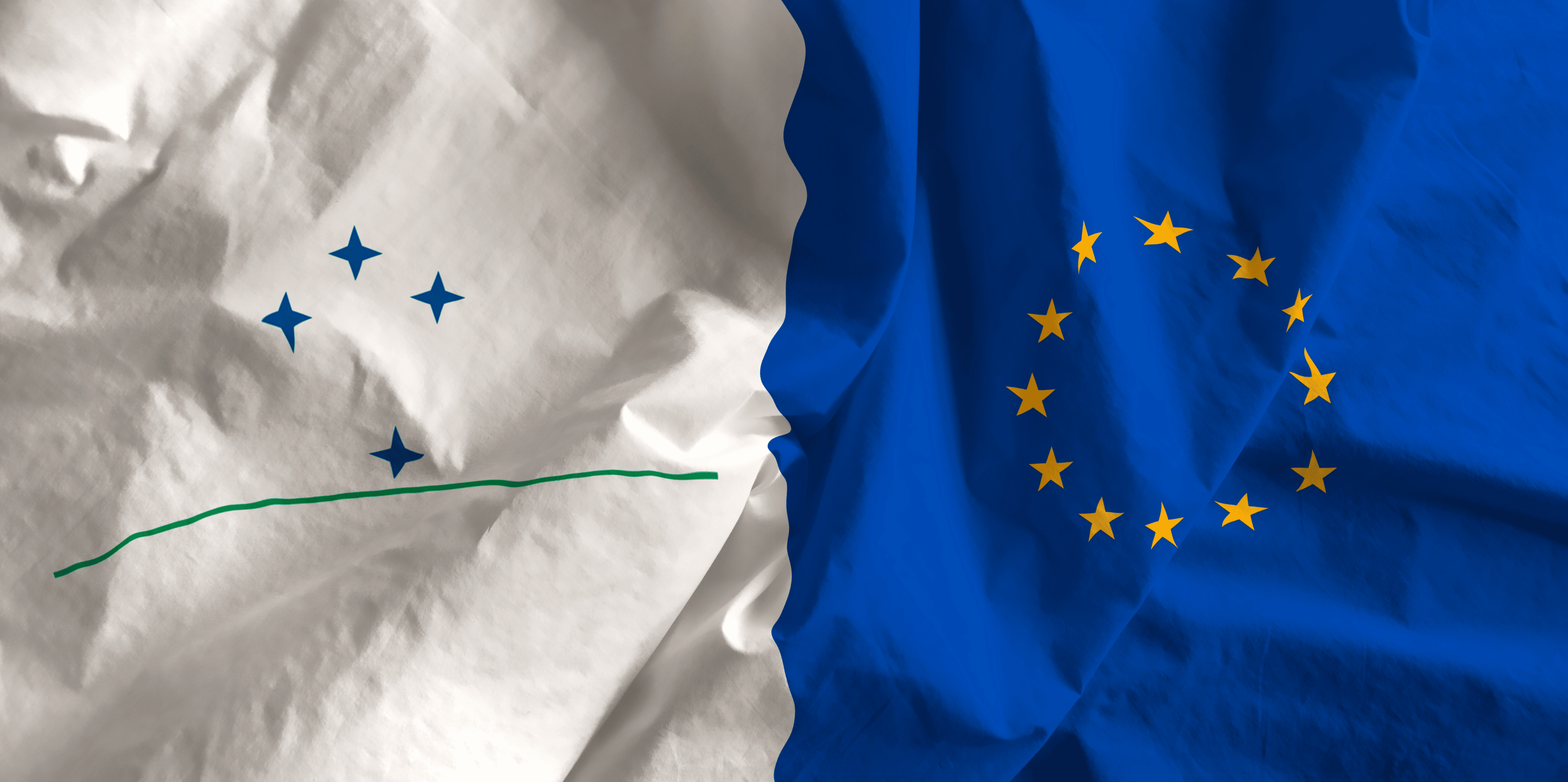
In Trade and Investment, the EU and Mercosur Should Be Global Neighbours
By Global Neighbours Advisory Board Member Marcos Troyjo
After more than 25 years of negotiations, the European Union has approved the trade agreement with Mercosur. Its timing is no coincidence. The accord arrives at a moment of profound inflection in the global economic and geopolitical order — and that is precisely what gives it renewed relevance.
International trade is no longer merely an instrument of economic efficiency. It has become a vector of security, power and strategic positioning. The world we inhabit today is marked by fragmentation, technological rivalry and rising geopolitical tension. In this environment, an agreement that connects Mercosur and the European Union creates one of the largest and relatively unimpeded economic spaces on the planet, encompassing more than 750 million people. Scale, predictability and productive integration have become scarce assets — and this agreement delivers all three.
This is why the Mercosur–EU accord should not be seen simply as a tariff-cutting exercise or a set of quotas. It is, rather, a project of economic architecture. By establishing shared rules, disciplines and dispute-settlement mechanisms, it creates predictability — arguably the most valuable currency in today’s volatile global economy. Predictability is decisive for long-term investment decisions. Trade generates flows; investment generates structural transformation. The most consequential impact of this agreement will therefore lie not only in the reduction of tariffs, but in the incentives it creates for investment, value-chain integration and the modernisation of the business environment.
I was directly involved in the negotiations when the agreement was technically concluded in 2019. At the time, there was an expectation that ratification would follow swiftly. That did not happen. Political changes in Argentina, a more protectionist phase in parts of South America, internal resistance within Europe and, soon after, the Covid-19 pandemic all contributed to delays. But the decisive variable has been geopolitics.
Since 2019, the intensification of US-China rivalry has fundamentally reshaped global supply chains. More recently, the return of Donald Trump to the US presidency — with an explicit tariff-driven agenda — has accelerated strategic decision-making in Europe. What had once been desirable became necessary. European negotiators had long expressed concern about being hostage to unilateral decisions by a single power. The response was clear: deepen robust, rule-based agreements between regions. The Mercosur deal moved from the drawer to the table because it became a strategic imperative.
There are no vacuums in geopolitics. If Mercosur fails to integrate with premium markets through comprehensive agreements, others will fill that space — often on terms that are less favourable in areas such as intellectual property, regulatory discipline, competition and government procurement. The risk of inaction was the gradual isolation of Mercosur from higher value-added global chains. This agreement mitigates that risk and repositions the region at a more sophisticated level of international economic insertion.
That said, the final text is not identical to the version agreed in 2019. The reopening of negotiations led to meaningful setbacks. Tariff phase-outs in the automotive sector were extended to as long as 25 years, diluting efficiency gains. The government procurement chapter lost ambition, despite its potential to enhance transparency, reduce costs and increase competition. These concessions make the agreement less ambitious than it could have been.
Even so, the economic gains remain significant. The agreement represents a structural advance for the economy of my country — Brazil — particularly for consumers, exporters and the country’s long-term productive modernisation. It is also likely to generate a positive bias in European foreign direct investment flows into Mercosur.
In agriculture, despite the limited ambition of meat quotas, the agreement delivers substantial market opening. The EU will reduce tariffs to zero on approximately 80 per cent of Brazilian agricultural tariff lines over a period of up to ten years. This is no small achievement in one of the most protected agricultural markets in the world. For Brazilian agribusiness, it means greater predictability, broader access and improved long-term planning conditions.
For industry, the design is balanced. A large share of Brazilian industrial exports will see tariffs eliminated in the short term, boosting external competitiveness. At the same time, Brazil’s own tariff reductions will follow a long and generous transition schedule, allowing firms time to adapt, invest and raise productivity. Avoiding abrupt shocks is essential if trade liberalisation is to translate into sustainable gains.
One of the least discussed — yet most strategic — elements of the agreement lies in its rules of origin. The flexible rules negotiated in 2019 have the potential to significantly enhance the competitiveness of Brazilian industry, which remains among the most protected in the world. By allowing greater use of inputs from multiple origins without loss of preferential access, these rules facilitate integration into European value chains, attract investment and support the production of higher value-added goods.
Environmental standards are often cited as a potential barrier in Europe. They can indeed be — but they can also turn into a competitive advantage. Brazil, for examples, is an environmental and agro-industrial powerhouse. In many respects, it is a major exporter of sustainability. What has been lacking is not performance, but communication. As the agreement comes into force, Brazil must intensify its engagement with European partners to convey its environmental credentials. In areas such as sustainable agriculture, biofuels, green hydrogen, renewable energy and critical minerals, Brazil is well positioned to emerge stronger.
Concerns persist that Brazilian industry may struggle with European competition. Competition exerts pressure; permanent protection anaesthetises. The agreement provides long transitions and gradual liberalisation. More importantly, it creates conditions for European capital to invest in Brazil and produce for global markets from Brazilian soil. The real gain lies not in a zero-sum contest between imports and domestic producers, but in productive, technological and financial integration.
French opposition to the agreement has drawn attention, but it is largely rooted in domestic politics. European agriculture — particularly in France — is highly specialised, and direct competition with Mercosur is limited. Meanwhile, French industrial firms, banks, energy companies and consultancies have welcomed the deal. The opposition s more symbolic than structural.
This brings me to what I have called “ESG 2.0”. Today, ESG stands for Economy, Security and Geopolitics. An agreement that expands markets and investment, reduces vulnerabilities in food and energy supply, and strengthens alliances based on rules is practising the new ESG. The Mercosur–EU agreement is one of the few in the world that addresses all three dimensions simultaneously. It functions as a form of insurance against systemic uncertainty.
Yet trade agreements do not generate benefits by themselves. Countries must shape up to them. The preparedness of Brazil’s productive sector remains uneven. The mobilisation of the private sector — particularly organisations supporting small and medium-sized enterprises — will be decisive. Without it, the country risks watching opportunity pass by.
Ultimately, the agreement’s greatest value lies in its potential to catalyse domestic reform. Greater exposure to international competition intensifies pressure for tax reform, fiscal predictability, improved logistics, regulatory certainty and innovation. The agreement opens doors, but it does not replace reforms. The most important trade deal Brazil needs to sign is with itself.
If Brazil does its part, the outcome will be a more productive, integrated and resilient economy. If it does not, the country will merely have signed a good agreement without reaping its benefits. Trade agreements are not panaceas. They amplify reform — they do not substitute for it.
In one sentence, the Mercosur–EU agreement is the most ambitious project of Brazil’s competitive integration in a generation — and a rare bet on cooperation, trade and investment in a world that is increasingly fragmenting.
Marcos Troyjo is a Distinguished Fellow at Insead and a Transformational Leadership Fellow at Oxford University. A former Foreign Trade Envoy for Brazil and multilateral bank chief, he was negotiator of the EU-Mercosur Agreement. He serves as a Global Advisor for the European Investment Bank (EIB) and sits on the Advisory Board of Global Neighbours.