The December edition of the Global Neighbours Breakfast Club focused on developments in Central Asia. With high-level speakers and participants from the international community, business and think tanks, the session offered insights into regional dynamics, key challenges and emerging opportunities for cooperation and investment.
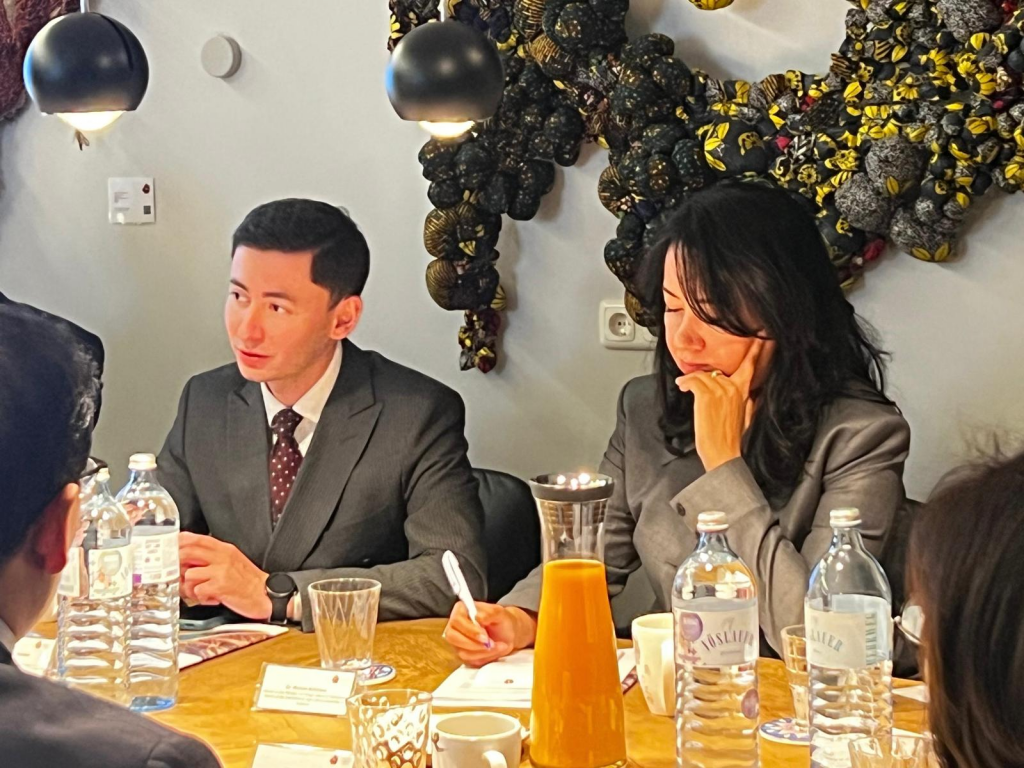
As the main speaker, Dr. Munira Aminova, Advisor to the Foreign Minister of Uzbekistan and Rector of the International Agriculture University in Tashkent, outlined the structural challenges facing the region, including water scarcity, border disputes inherited from Soviet-era delimitations, and the ecological issues as this of the Aral Sea desiccation. She highlighted progress made in recent years, particularly in regional dialogue and border demarcation, as an important step toward stability.
Dr. Aminova emphasized the growing importance of interregional cooperation frameworks such as the C5+1 platform and the recently signed Enhanced Partnership and Cooperation Agreement (EPCA) between the EU and Uzbekistan. She identified promising fields for European engagement, including critical minerals, logistics, IT and digitalization, green energy, and agriculture.
Mansurjon Rasulev, Head of the Investment Promotion Agency of Uzbekistan, presented recent economic reforms and the country’s efforts to attract international investors. He highlighted dynamic developments in sectors such as renewable energy and infrastructure, and stressed that long-term economic growth in Uzbekistan, which has been around 6% in recent years, is increasingly driven by private investment.
Joining online, Prof. Sergei Yazvenko presented his publication in the Global Neighbours Insights series on “Cross-Border Issues and Cooperation in Central Asia: Investment and Development Opportunities”, where he outlined key structural challenges shaping the regional agenda, including water management, energy systems, trade and customs barriers, logistics and environment.
The discussion that followed focused on ways to foster cooperation and create additional engagement opportunities for Europe. Central Asia is an increasingly attractive and developing regional market, serving not only as a growth market in its own capacity but also as a strategic bridge to major markets in South Asia and China. At the same time, China and Russia remain major actors in the regional market, Middle Eastern countries are becoming increasingly active, while European presence on the ground remains relatively limited. Central Asia’s approach is not to reduce the share of established investors and partners, but rather to engage those actors who have so far been less involved – a perspective that offers valuable insight for Europe.