
An Afro-European Economy: What Happens When Europe Finally Bets on Africa While Africa Bets on itself
The following piece has published on the 28th of July by W. Gyude Moore a former Global Neighbours Inaugural Visiting Fellow.
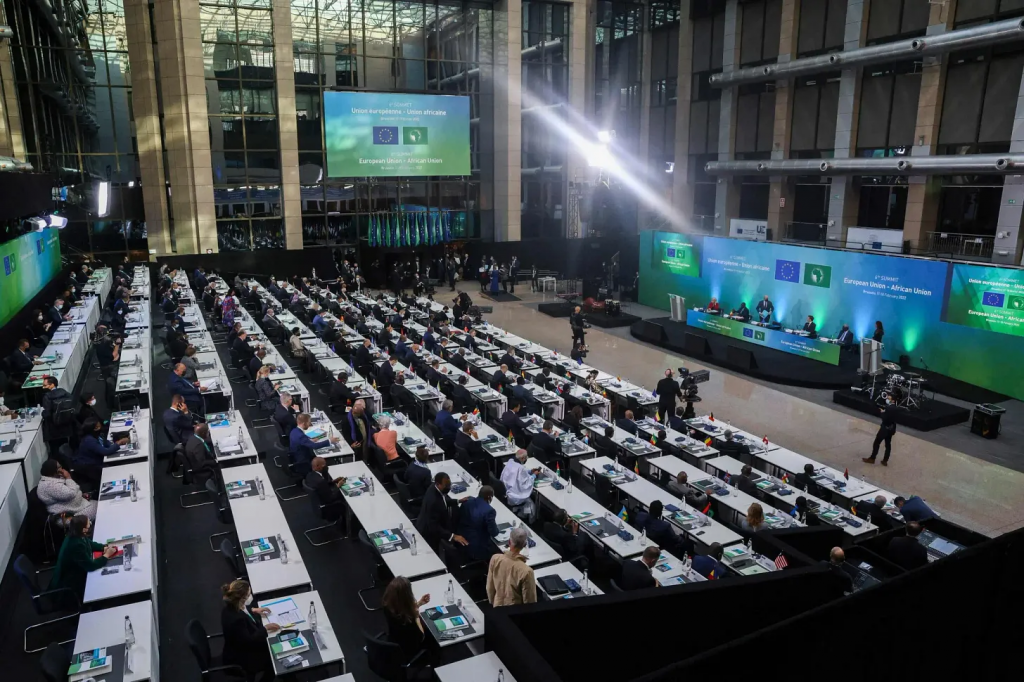
This year, the EU-Africa summit will be held in Luanda, Angola in November from the 24th to the 26th. Aimed at “deepening cooperation” between Europe and Africa, this will be the seventh edition, over the last 25 years of AU-EU summitry. Even the most optimistic observer will struggle to find substantive achievements from the triennial meeting. Take China, for example, which has also had an Africa-China summit (FOCAC) since the year 2000. Out of that relationship has come “nearly 100,000 kilometers of roads [new and upgraded], and more than 10,000 kilometers of railways.” Per the Chinese ambassador to Nigeria, over that same period China has “built 100 seaports across Africa.” Europe which has had a much longer and deeper history in Africa cannot make similar claims. But the Africa-Europe relationship can deliver significantly better outcomes for both peoples – it will require reimagining the relationship.
Even as they meet in Luanda, a silent truth lurks in the sidelines, an inescapable shadow over every European policy debate: Europe is aging, while the center of gravity in the global economy has shifted eastward and Europe, firmly in America’s shadow, risks irrelevance. As the Draghi Report notes, the global paradigm of European prosperity is fading and it looks like EU companies now face “both greater competition from abroad and lower access to overseas markets… All the while, geopolitical stability is waning, and [Europe’s] dependencies have turned out to be vulnerabilities.
Africa’s situation is equally dire. Its mineral wealth and youthful population, notwithstanding, its share of global goods in trade in goods and services remains a dismal 3 percent. It too is stalked by the risk of becoming permanently stuck in its role as provider of raw materials, without the capital, technology, jobs or opportunities it desperately needs. Both continents face existential challenges—but each also holds the solution to the other’s dilemma.
But what if, instead of retreating into nostalgic protectionism or defensive posturing, Europe did something bold — something transformational? What if it placed its bet on Africa?
Imagine a world where the Mediterranean is no longer a barrier but a bridge. Where Europe’s aging, capital-rich economies invest deeply in Africa’s youthful, labor-abundant nations. Where the flow of skilled African workers into Europe isn’t treated as a crisis, but as the cornerstone of industrial renewal. In this world, the partnership between Africa and Europe does not replicate the asymmetry of the past; it redefines the architecture of the future.
This isn’t fantasy. It’s an urgent strategic pivot — and it’s still within reach.
Europe’s Existential Dilemma
The demographics are clear. Europe is growing old. Its working-age population is shrinking. “The EU is entering the first period in its recent history in which growth will not be supported by rising populations. By 2040, the workforce is projected to shrink by close to 2 million workers each year.” Entire industries — from manufacturing to elder care — face chronic labor shortages. By 2050, Europe will have 95 million fewer working-age people than it did in 2020. “Nearly two thirds (63%) of small and medium-sized businesses said in a recent survey that they cannot find the talent they need.” The European Commission “has identified 42 occupations which have shortages.”
Africa, by contrast, is teeming with energy. By 2050, one in four people on earth will be African. The continent will boast the largest labor force in the world and a consumer class rivaling that of India or China. Yet without sufficient investment, this potential becomes peril — manifesting as unemployment, instability, and desperation.
The status quo —, what the next Africa-EU summit is on course to consolidate – Europe’s cautious grants and declines in substantive ODA, fragmented development aid, and barbed-wire border fences — will not hold. What’s needed is vision.
A New Bargain: Europe’s Capital, Africa’s Consumer Base & Workforce
Picture a new economic compact between Europe and Africa. One in which European capital flows into African infrastructure, agriculture, and green manufacturing — as investment. In return, Europe gets something it desperately needs: labor and reprieve to the death spiral of its pension systems and other safety nets.
But not just any labor. A deliberate policy framework builds African technical universities and trade schools — co-funded by European governments and firms — that train welders, machinists, solar engineers, caregivers, and IT specialists. A coordinated visa policy allows the graduates of these institutions to work in Europe, plugging skills gaps and sending remittances home. The circulation creates a regenerative loop where African talent gains experience abroad and brings capital, skills, and ideas back home.
We’ve seen glimmers of this before. North African workers helped build postwar France. African nurses have held up the NHS. But these were accidents of empire, not deliberate strategies of partnership. This time, it must be different. It must be mutual.
Building the Afro-European Economy
Now imagine this compact deepening. African cities begin to absorb European supply chains seeking resilience in the wake of an overly Asia-centric status quo. European VCs are on the ground floor of the creation of African startups that will dominate the emerging consumer market – earning significant returns for European pension funds and other investors. In this world, a Senegalese factory supplies precision parts to German automakers, such as we are now seeing in Morocco. A Ghanaian coder works remotely for a Finnish AI startup. A Nigerian dairy cooperative exports to French supermarkets under shared EU-AU standards.
Airbus and Siemens don’t just operate in Africa — they manufacture there. In exchange, Europe gains market share in the fastest-growing consumer markets in the world. African migrants help shore up European pension systems, while their home countries benefit from steady remittances and returning citizens with global experience.
Together, Africa and Europe begin to form a third pole in the global economy — not defined by dominance, but by complementarity. Asia has scale. The US has innovation. The Afro-European bloc would have balance: Africa’s youth and resources matched with Europe’s capital, technology, and governance standards.
This isn’t about competing with China or replacing America. It’s about ensuring that the future isn’t something that happens to Europe and Africa — it’s something they build, together. This future is not fantasy – it is within reach. Currently, the EU-27 is still Africa’s largest trading partner and the combined African market is the EU’s fourth largest trading partner. It is worth noting that this outcome is not so much shaped by intentional policy outcomes as it is by the gravity of trade and proximity. If we could achieve this doing business-as-usual, it becomes easy to imagine what is possible with a decades-long direct policy intervention.
The Risk of Inaction
To be clear, this future is not inevitable. Europe could continue its muddled approach: underinvesting, overregulating, and obsessing over border security. If it does, Africa will turn elsewhere — to China, to Turkey, to the Gulf — and Europe will find itself isolated, its influence eroded, its economy stagnant. The continent with the greatest to gain from Africa’s rise is Europe. And yet, too often, it acts as if it has the most to fear. Should Europe manage to see beyond its historical anxieties, it will find solutions in the very place it once overlooked.
A Closing Note
We are entering an age of demographic divergence and economic realignment. The decisions Europe makes now will determine whether it becomes a museum filled with vestiges of a “glorious” past or a central player in an Afro-European century.
I would focus on three areas of immediate concern:
Across Europe, many countries are either exploring or negotiating labor mobility agreements with governments in Africa. Among European Germany, Italy, Spain and even Serbia are either signing or negotiating labor mobility contracts with various African countries. Creating an AU-EU standard will ensure that these contracts are mutually beneficial. Global Skills Partnerships offer such a model that advances the interests of both sending and receiving countries.
A “scramble” for critical minerals among China, Europe, India, the United States, the UAE and others. Very few of these plans include processing in Africa. Europe can, through Global Gateway, offer African partners a plan that includes processing minerals in Africa. For example, a BloombergNEF report found that “Precursor material produced at plants in the DRC could be cost competitive with material produced in China and Poland but with a lower environmental footprint.” Europe can go beyond simply extracting minerals from Africa.
The energy demands of processing minerals in Africa are very high and present an opportunity for Europe to enter “Energy Security Compacts”, with various African countries. These arrangements would, among other things “reduce energy dependence on geostrategic competitors; diversify supply chains; bolster economic stability; advancing the energy transition.” This would advance both European and African interests.
Africa doesn’t need a patron. It needs a partner. And if Europe has the courage to embrace this partnership, both continents can secure their place in a reshaped global order.
Read the original article at: An Afro-European Economy: What Happens When Europe Finally Bets on Africa