
AI Industry at a Turning Point as Chatbots Hit Their Limits, Executives Say
By Du Zhihang

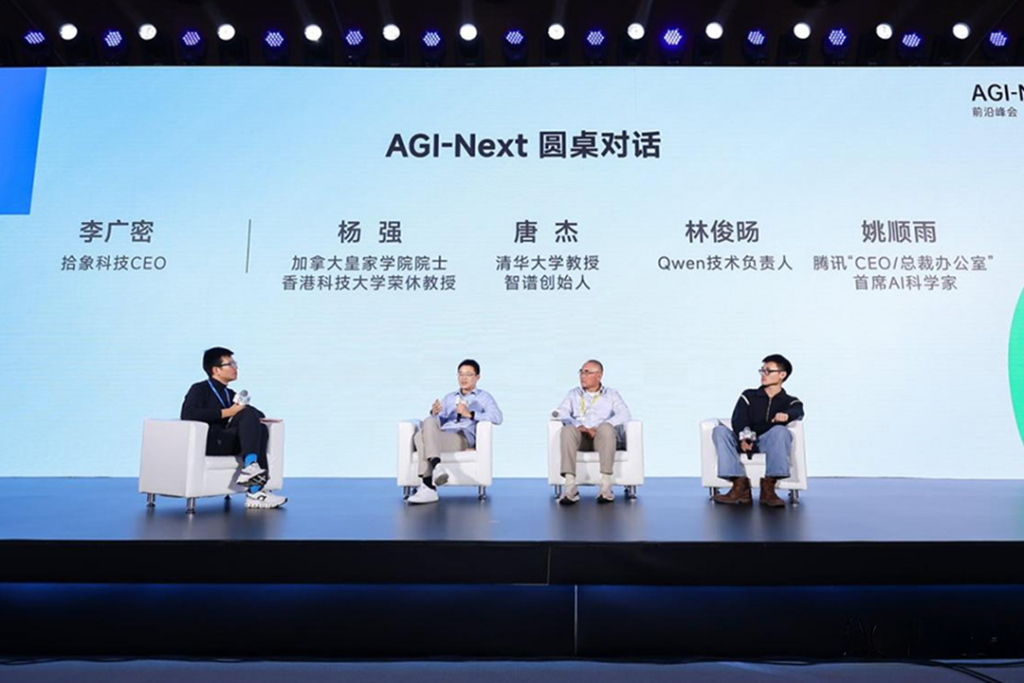
Several Chinese artificial intelligence (AI) executives warned that the chatbot-driven boom is nearing its limits and called for a pivot toward autonomous agents capable of handling complex real-world tasks, as they met at Tsinghua University to map out the industry’s direction for 2026.
At the AGI-Next Frontier summit on Saturday, speakers agreed that while domestic developers enjoyed a strong 2025 — particularly in open-source large language models (LLM) — chat-based interfaces are reaching their limits. They also warned that the technological gap between China’s models and elite U.S. closed-source systems remains wide and could even expand.
Tang Jie, founder of Zhipu AI and a professor at Tsinghua University, said the launch of DeepSeek in early 2025 sent shockwaves through the industry. Although the model delivered strong performance, Tang said it also signaled that the “chat” paradigm was approaching its ceiling. Adding personality or emotional tone to chatbots, he argued, is unlikely to yield meaningful gains beyond what DeepSeek already offers.
Zhipu shifted its focus in 2025 toward programming-oriented models and AI agents — systems designed to solve problems rather than merely converse. The company released its GLM-4.5 model in July and open-sourced AutoGLM (9B), a lightweight, interaction-focused agent model, in December.
Chinese models made major gains in 2025, effectively displacing U.S. open-source rivals such as Meta Platforms Inc.’s Llama on third-party leaderboards like Artificial Analysis, where they occupied nearly all of the top five positions. However, Tang urged caution when looking toward 2026, stressing that China has not closed the gap with top-tier U.S. closed-source models and faces the risk of falling further behind.
Tang expected the next stage of AI development to focus on multimodal integration. While 2025 was a year of rapid adaptation, future LLMs will need to see and hear like humans, while also developing stronger memory and continuous learning capabilities to better absorb and apply human knowledge, he said.
Moonshot AI founder and CEO Yang Zhilin echoed the emphasis on agents. In 2025, Moonshot launched Kimi K2, which the company describes as China’s first agent model capable of executing hundreds of complex tool-invocation steps. Yang said the company’s next focus is improving models’ attention and reasoning across long, multi-step tasks.
Scaling AI is not simply about adding more computing power, Yang said, quoting Apple Inc. co-founder Steve Jobs to argue that true progress also requires “taste.” “Building a model is essentially creating a worldview,” Yang said, noting that agents shaped by a CEO, a designer or a musician would behave very differently. As a result, future models are likely to develop distinct personalities rather than converging into a single standard.
Yao Shunyu, Tencent Holdings Ltd.’s chief AI scientist and a former OpenAI researcher, pointed to a growing divide in 2025 between consumer-facing and enterprise AI applications. Consumer products such as ChatGPT continued to iterate technically, but the user experience remained largely similar to a search engine — cheap, general-purpose and limited in depth.
By contrast, enterprise users showed a strong willingness to pay for reliability and precision. Tools such as Anthropic’s Claude Code, Yao said, demonstrated that businesses prefer stable, high-accuracy systems and reject cheaper alternatives that require frequent human correction.
Discussing Tencent’s strategy, Yao said the company plans to leverage its consumer-focused strengths to build models that better understand user context. Rather than simply increasing pre-training scale or reinforcement learning intensity, he argued that AI development should focus more on understanding a user’s specific situation — potentially drawing on chat history to improve responses.
Lin Junyang, technical lead for Alibaba Group Holding Ltd.’s Qwen team, predicted that “AI training AI” will soon become a reality but warned that machines still lack a deep understanding of human preferences. Unlike recommendation algorithms that simply reinforce existing tastes, AI systems embedded in everyday life face far more ambiguous and difficult-to-measure goals.
Although current models can process much longer contexts, Lin said, that does not necessarily make them smarter. He argued that AI must evolve from passively responding to commands toward actively interpreting environmental signals and taking action. This shift, however, will require much stronger AI safety education to ensure that autonomous systems act in alignment with human values and intentions.
Contact editor Wang Xintong (xintongwang@caixin.com)
caixinglobal.com is the English-language online news portal of Chinese financial and business news media group Caixin. Global Neighbours is authorized to reprint this article.
Image: VRVIRUS – stock.adobe.com