IMF Opens Shanghai Center to Deepen Asia-Pacific Ties
By Ding Feng

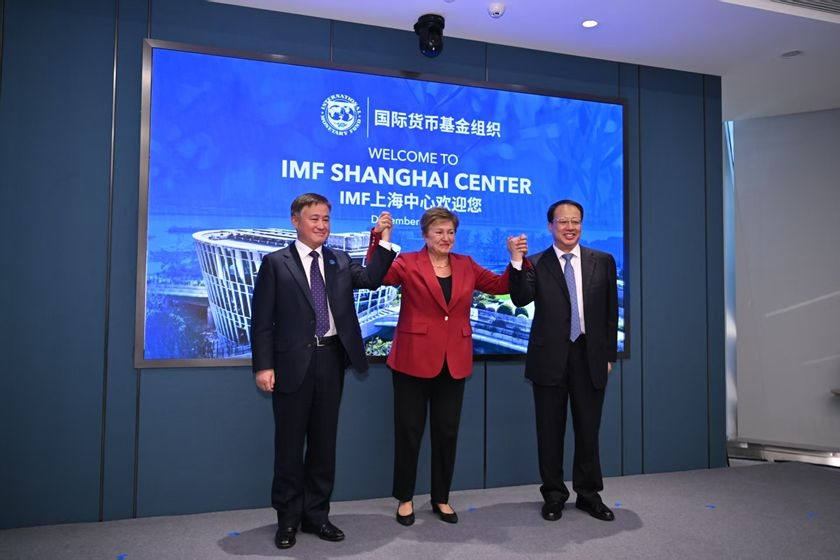
The International Monetary Fund inaugurated its Shanghai regional center on Monday, aiming to bolster ties with the Asia-Pacific and advance research on emerging markets.
The launch of the center — the IMF’s 21st center worldwide — underscores closer cooperation between the Washington-based institution and China, as the country cements its role in shaping regional economic policy and financial stability across developing nations.
IMF Managing Director Kristalina Georgieva attended the opening alongside People’s Bank of China Governor Pan Gongsheng and Shanghai Mayor Gong Zheng. First proposed 18 months ago, the Shanghai office is designed to foster dialogue with Asia-Pacific economies, focus on research pertinent to middle-income nations and support tailored capacity-building initiatives, according to a PBOC statement.
Pan said the center’s opening is significant for deepening cooperation between the IMF and China, promoting macroeconomic policy exchange and coordination among Asia-Pacific countries, and maintaining regional and global financial stability.
Georgieva said the new hub would help members navigate challenges from demographic changes, evolving global trade flows and the transformative impact of artificial intelligence. She emphasized that the Shanghai center would act as a bridge between IMF headquarters and Asia-based economists and a platform for regional policy research.
She noted that Asia’s previous growth drivers — such as a growing labor force and industrialization — are fading due to aging populations. Going forward, the private sector must take the lead, with productivity and resource reallocation as the focus.
The IMF chief laid out three priority areas for the center’s research. The first is how to improve the business environment to unlock the full potential of the private sector, which involves reducing red tape and regulatory barriers. The second is how to best leverage new technologies, such as artificial intelligence, balancing the need to allow innovation while safeguarding financial stability. Georgieva noted that IMF research suggests AI could boost annual economic growth by 0.8 to 1 percentage point.
Thirdly, the center will explore how countries can maintain trade as an engine of growth amid shifting global patterns. Reforms to deepen regional integration, such as reducing nontariff barriers in Asia, could increase long-term GDP by 8%, she said, adding that further research is needed to identify specific trade obstacles and policies to remove them.
The IMF appointed Johannes Wiegand, a senior staff economist with extensive experience in global and regional policy, as the first director of the Shanghai center.
caixinglobal.com is the English-language online news portal of Chinese financial and business news media group Caixin. Global Neighbours is authorized to reprint this article.
Image: hardvicore – stock.adobe.com