
BYD Breaks Ground on Cambodia EV Plant as Part of Global Expansion
By Zhai Shaohui and Denise Jia

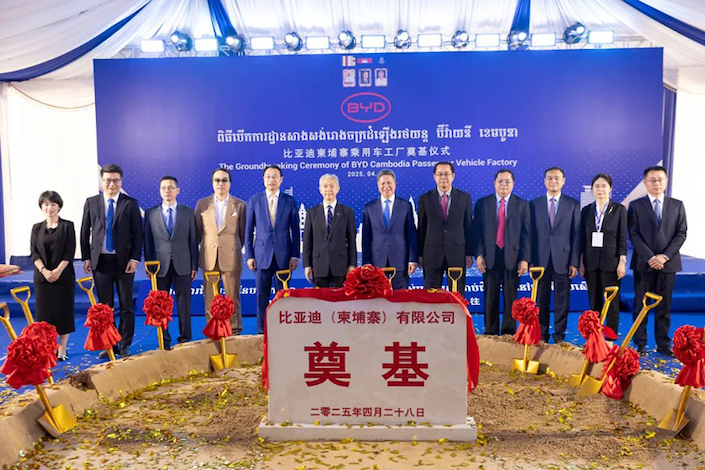
BYD has broken ground on a $32 million passenger electric vehicle plant in Cambodia, marking its latest move to localize production as part of a broader global expansion that has seen the Chinese automaker become a top-selling EV brand in markets from Brazil to the UK.
The company said on Tuesday that the plant in Sihanoukville Special Economic Zone is expected to be finished by October 2025, with production starting in the fourth quarter. With an, The facility, with an annual capacity of 10,000 units, will make both battery EVs and plug-in hybrid EVs.
The Council for the Development of Cambodia, which oversees investment projects and private sector growth in Cambodia, confirmed the site will be a CKD (completely knocked down) assembly plant.
The move is part of BYD’s broader “passenger car going global” strategy, launched in May 2021, which has seen the company enter more than 100 countries and regions. The carmaker is rapidly increasing localized production to sidestep trade barriers and reduce export costs.
BYD’s momentum in overseas markets is gaining speed. In the first quarter of 2025, it became Brazil’s best-selling new energy vehicle (NEV) brand with 21,400 units sold. It also led sales in Thailand, delivering 8,800 NEVs — far ahead of domestic rivals.
The company outpaced Tesla in Australia, Italy and Britain during the same period. U.K. sales soared to 9,300 units, up 621% year-on-year, making BYD the fastest-growing car brand in the British market.
These gains have translated into strong financial results. BYD’s overseas revenue grew from 91.45 billion yuan ($12.5 billion) in 2022 to 221.88 billion yuan ($30.5 billion) in 2024, with year-on-year growth rates of 43.1%, 75.2%, and 38.5% respectively — outpacing its domestic revenue growth in both 2023 and 2024.
To support booming exports, BYD has begun building its own maritime logistics fleet. Four EV-dedicated cargo ships are already operational, strengthening the company’s ability to fulfill large-scale overseas orders.
According to the China Association of Automobile Manufacturers, BYD exported 214,000 vehicles in the first quarter, doubling year-on-year and accounting for nearly half of China’s total NEV exports during the period.
In 2024, BYD exported 433,000 NEVs, about a third of the national total. The company now aims to ship between 800,000 and 1 million passenger vehicles overseas in 2025, representing a year-on-year increase of up to 131%.
While China still enjoys labor cost advantages, overseas tariffs and regulations have prompted Chinese carmakers to localize production. BYD’s core overseas markets — Europe, Southeast Asia, and Latin America — have become key targets for capacity investments.
In Europe, BYD is building a 200,000-unit plant in Hungary, due to be completed within three years. It is also building a 150,000-unit facility in Turkey, due online by late 2026. Turkey’s customs union with the European Union makes it a strategic location despite being outside the bloc.
In Southeast Asia, BYD’s Thai plant began production in July 2024 with a 150,000-unit annual capacity. Facilities in Indonesia and Cambodia are being built, each targeting 150,000 and 10,000 units a year respectively.
In Latin America, BYD announced in July 2023 plans to build three factories in Brazil, including one for passenger EVs with a 150,000-unit annual capacity. The launch, originally planned second half of 2024, has been delayed until.
The company also began operations at its Uzbekistan plant in June 2024. With an initial output of 50,000 units a year, it marks BYD’s first manufacturing footprint in Central Asia.
Contact reporter Denise Jia (huijuanjia@caixin.com)
caixinglobal.com is the English-language online news portal of Chinese financial and business news media group Caixin. Global Neighbours is authorized to reprint this article.
Image: fotocebi – stock.adobe.com